Uzair Moosa, CEO of Swapp, on Building an Asset-Light Car Platform for the GCC
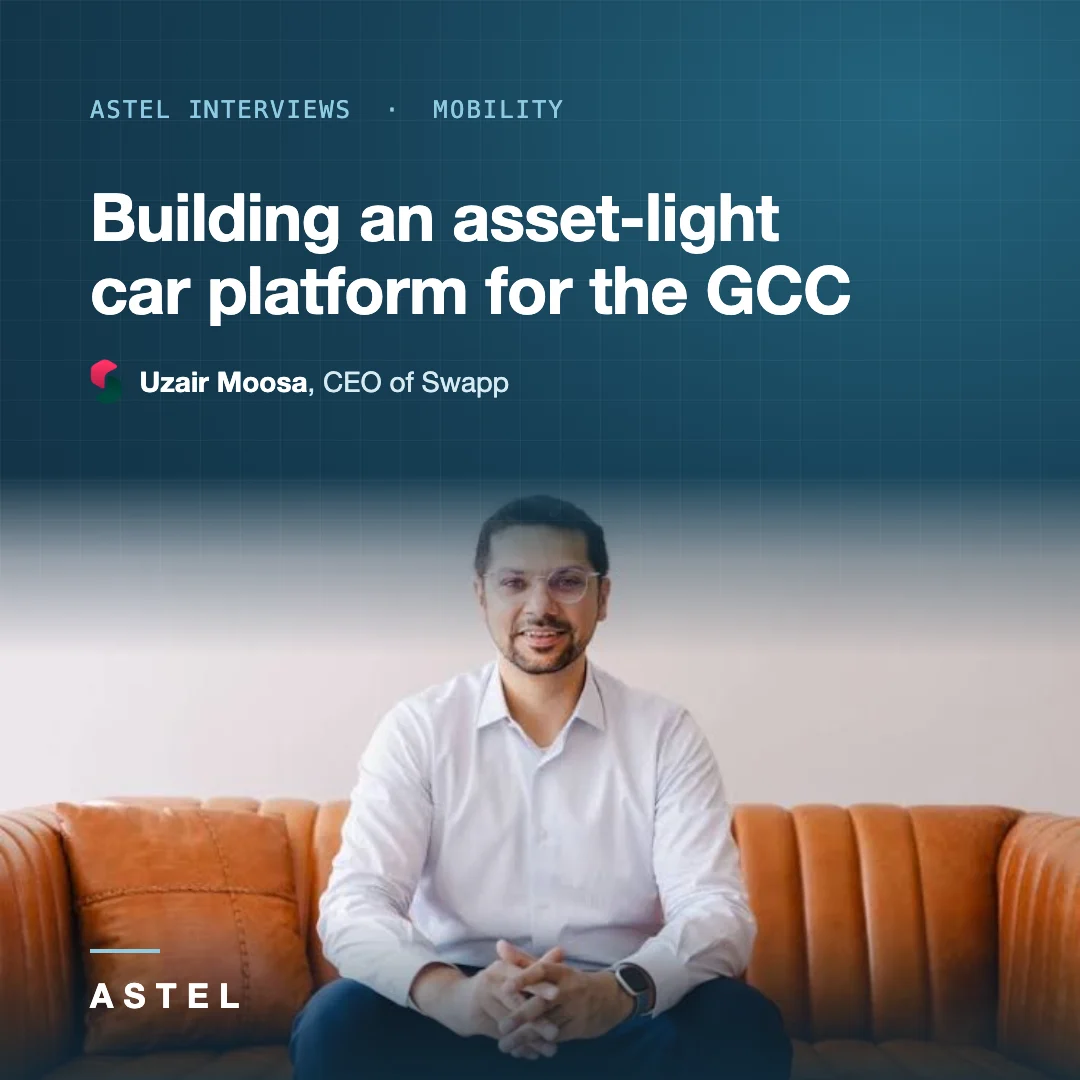
Swapp is a car rental and subscription platform based in the UAE. It connects fleet owners with customers who want to find, pay for and receive a car without the usual paperwork, and Careem has taken an equity stake in the company. Its CEO, Uzair Moosa, was Careem's first employee in Saudi Arabia before he took over Swapp and rebuilt it.
We asked him about the turnaround, the move to a hybrid fleet model, how he builds partnerships with companies like Careem and Legend, and where car access in the region is heading.
The story behind Swapp
What was the initial “aha!” moment or personal observation that inspired you to take on the Middle East’s traditional car rental and leasing space?
The real “aha” moment for me came when I saw that the underlying customer problem was much bigger than the business model we had at the time.
The traditional car rental and leasing industry across the region is highly fragmented and operationally heavy. For customers, it often means paperwork, deposits, opaque pricing, long commitments and an inconsistent experience. At the same time, there are thousands of vehicles sitting across rental companies and fleet owners that could be distributed far more efficiently.
I saw an opportunity to fundamentally reposition Swapp around that problem: building the technology and distribution layer connecting fragmented automotive supply with digital consumer demand.
Rather than becoming another traditional rental company, the vision was to build an asset-light mobility platform that could simplify access to cars for consumers while helping fleet owners distribute their inventory more efficiently.
That became the foundation for how we rebuilt and scaled Swapp.
Given your executive background at companies like Careem, how did your prior operational experiences shape how you approached building Swapp?
Careem probably shaped my thinking more than anything else.
I joined Careem very early and was the first employee in Saudi Arabia. At the time, there really was no playbook. You had to build supply, generate demand, understand local consumer behaviour and solve operational problems simultaneously.
Saudi Arabia eventually became Careem’s largest market, and one of the biggest lessons I took from that experience was that marketplaces are not built purely through technology. Technology enables the marketplace, but operational discipline makes it work.
You need to understand liquidity, supply economics, customer experience and local market dynamics at a very granular level.
I carried that philosophy into Swapp when we started rebuilding the business.
We have tried to remain relatively asset-light, use partnerships to scale faster than we could independently, and build technology around real operational problems rather than technology for its own sake.
My experiences after Careem, including running and operating other growth businesses, also taught me the importance of capital efficiency. Growth is important, but growth without sustainable economics eventually catches up with you.
In the early stages, what was the biggest gap in the mobility market that you felt traditional players were completely missing?
The biggest gap was convenience combined with flexibility.
Consumers increasingly expect mobility to work like every other digital service in their lives. They want to discover a car, understand exactly what it costs, complete the transaction digitally and have the vehicle delivered without going through a complicated offline process.
But much of the rental and leasing industry was still operating through fairly traditional systems.
On the other side, fleet owners often have significant inventory but limited digital distribution.
Swapp essentially sits between those two problems.
We want to make accessing a car significantly easier for the consumer while giving fleet owners and automotive partners a much more efficient digital distribution channel.
Navigating challenges and key milestones
Building a startup rarely follows a straight path. What was one of the most critical pivots or difficult decisions you had to make while scaling the platform?
One of the most important decisions we made while repositioning Swapp was recognising that a pure marketplace model was not enough.
A marketplace is extremely attractive theoretically because it is capital-light. But in car rental and subscription, the customer experience ultimately depends on the quality, availability and consistency of the vehicle supply.
If you do not have enough influence over that supply, it becomes difficult to guarantee the experience.
So we evolved from being a pure marketplace into what I would describe as a hybrid marketplace.
We still fundamentally believe in an asset-light model, but we have developed much deeper strategic relationships with fleet partners and created structures where dedicated vehicles can be supplied into the ecosystem.
The important distinction is that we do not necessarily need to own those assets ourselves.
That evolution has given us greater control over availability, pricing and customer experience without turning Swapp into a traditional balance-sheet-heavy rental company.
You’ve shifted Swapp from a pure marketplace model toward a hybrid model with dedicated fleet partners. What operational challenges did you face along the way, and how did you overcome them?
Supply is probably the hardest part of this business.
When you are dependent on fragmented third-party inventory, you can face sudden changes in pricing, availability and vehicle quality. And as you grow, what works operationally with 100 cars does not necessarily work with 1,000 or 2,000 cars.
As we rebuilt the company, we realised that we needed to move away from purely transactional supplier relationships and toward deeper strategic partnerships.
A good example is our partnership with Legend. Instead of simply negotiating vehicle-by-vehicle supply, we have built a joint venture structure where both sides have aligned economics and can grow the fleet together.
That changes the relationship completely.
Our role is increasingly to bring technology, demand, utilisation and operational capability, while our fleet partners bring asset ownership, purchasing capabilities and automotive expertise.
If each partner focuses on what they are best at, the overall ecosystem becomes much more scalable.
Entrepreneurship brings immense pressure. What was one of your toughest moments as a leader, and what lesson did it teach you about resilience?
The toughest period was undoubtedly when I took over the business and we were trying to stabilise and rebuild Swapp.
The company was under significant financial and operational pressure. There were liabilities, supplier obligations, organisational challenges and uncertainty around some of the company’s most important commercial relationships.
At that point, you cannot solve everything simultaneously.
You have to identify what is existential, deal with those issues first, communicate honestly with the team and stakeholders, and then gradually rebuild credibility.
There were definitely moments where the easier decision would have been to walk away.
But one thing I have learned throughout my career is that businesses rarely fail because of one catastrophic event. They usually fail because a series of difficult problems are allowed to compound.
Resilience, therefore, is not just about enduring pressure. It is about continuing to make rational decisions when the environment around you is extremely uncertain.
Looking at Swapp today, the partnerships we have built, the improvement in the economics of the business and the opportunities ahead of us all came from decisions made during that very difficult period.
Growth, strategy and opportunities
Swapp has built deep strategic ties with major ecosystem players, such as Careem taking an equity stake and JV partnerships like Legend. How do you approach building partnerships that genuinely accelerate a startup’s trajectory?
I think the best partnerships solve something important for both sides.
Startups sometimes approach partnerships by asking, “What can this large company do for us?” I think the better question is, “What can we solve for them that is difficult for them to solve themselves?”
Careem is a good example.
They have enormous consumer reach and a very strong mobility brand. We have the technology, operational infrastructure and supplier ecosystem required to deliver longer-term car rental and subscription products.
Putting those capabilities together is significantly more powerful than either party trying to recreate what the other already has.
The same principle applies to our fleet partnerships.
With Legend, they bring deep automotive and asset capabilities, while we bring demand, technology and utilisation.
The strongest strategic partnerships have three things: complementary capabilities, aligned economics and a reason for both parties to keep investing in the relationship as it grows.
If those three things exist, partnerships can accelerate a company far faster than trying to build everything internally.
As you expand into new markets like Saudi Arabia, what do you see as the biggest opportunities, and distinct local challenges for digital car mobility across the GCC?
Saudi Arabia is particularly exciting because of the scale of the market and the pace at which consumer behaviour is changing.
It is a very digitally engaged population, and expectations around convenience and digital experiences have changed dramatically.
At the same time, car ownership remains extremely important, which creates an interesting opportunity between traditional ownership, rental and subscription.
I also know the Saudi market very well personally and professionally, having spent a significant part of my life there and having launched Careem in the Kingdom.
But every GCC market is different.
Regulation is different. Fleet economics are different. Consumer behaviour is different. The competitive environment is different.
One mistake companies make when they talk about “GCC expansion” is assuming that the same operating model can simply be copied across borders.
Our philosophy is therefore to enter markets through strong local demand and supply partnerships rather than building large organisations before we have proven the economics.
That is also why strategic partnerships are such an important part of our expansion strategy.
Having achieved key scale milestones and breakeven run rates, how do you balance rapid top-line growth with sustainable unit economics?
I think the market has changed significantly from the period when companies were rewarded almost exclusively for growth.
Growth still matters enormously, but the question we ask ourselves is slightly different: is each additional dollar of GMV making the business stronger?
We look very closely at gross margin, utilisation, contribution margin, customer acquisition economics and the amount of capital required to generate that growth.
The ideal model for Swapp is one where our technology and distribution scale much faster than our fixed cost base.
That is why partnerships are so central to the strategy.
If we can access millions of customers through large distribution partners and thousands of vehicles through strategic fleet partners, we can grow GMV without having to replicate the cost structure of a traditional rental company.
The objective is not simply to become bigger. It is to build a business where scale improves the economics.
Leadership, culture and vision
What traits or core values do you look for when bringing on core team members and executives to execute your vision?
The first thing I look for is ownership mentality.
In a scale-up, job descriptions become outdated very quickly. You need people who see a problem and instinctively try to solve it rather than asking whose responsibility it is.
The second is intellectual honesty.
I would much rather have someone tell me that an idea is not working than protect a decision because it was originally theirs. Startups have limited resources, so the speed at which you recognise mistakes matters enormously.
The third is comfort with ambiguity.
People coming from very large organisations sometimes expect established systems, teams and processes. In a company like Swapp, sometimes you are building the process while simultaneously running the business.
And finally, I value low ego.
Some of the best people I have worked with are extremely confident in their capabilities but do not need organisational hierarchy to validate them. Those tend to be the people who collaborate best and build strong teams around themselves.
How has your own role and perspective as CEO evolved from when Swapp was just an initial concept to leading a growing scale-up?
When I took over Swapp, my role was extremely operational.
When a business is going through a restructuring and rebuilding phase, the CEO can be involved in everything from supplier negotiations and fundraising to customer problems and cash flow.
As the company has matured, the role has had to change.
Increasingly, my job is to make sure we have the right people, sufficient capital, the right strategic partnerships and clarity around where we are going.
One of the harder transitions for any CEO is understanding that something being important does not necessarily mean you personally need to do it.
The organisation becomes stronger when decisions can increasingly be made without everything flowing through the CEO.
So my role today is moving from solving individual problems toward building the system, team and partnerships that allow Swapp to solve thousands of problems without me.
Looking 3 to 5 years down the road, what is your ultimate vision for Swapp, and how do you see consumer mobility habits shifting across the region?
I think the biggest shift will be from car ownership being the default toward access becoming increasingly flexible.
That does not mean people will stop owning cars. Particularly in the Middle East, the car will remain incredibly important.
But consumers will increasingly question why accessing a vehicle needs to involve a five-year financing commitment or a complicated traditional leasing process.
The boundaries between rental, leasing, subscription and ownership are going to become much less rigid.
Our ambition is for Swapp to become the infrastructure layer that enables that transition across the region.
We do not necessarily need to own thousands of cars.
We want to connect the region’s largest sources of automotive supply with the largest sources of consumer demand and provide the technology, payments, operations and intelligence sitting between them.
If we execute that well, Swapp can ultimately become much more than a car subscription company.
It can become the platform through which consumers access cars and through which automotive companies distribute and monetise their fleets across the region.